Where Does Your Junk Actually Go After It Leaves Your House?
Where Does Your Junk Actually Go After It Leaves Your House?
The truck pulls away with a couch, two mattresses and a broken refrigerator, and the problem is solved as far as you are concerned. Most people never think about the next part.
It is worth thinking about, because the answer varies enormously between companies. Some sort carefully and divert most of a load. Others drive straight to the nearest landfill. Both charge roughly the same, and only one of them tells you which they did.
The Sorting Happens Before the Landfill
A responsible hauler does not treat a load as one undifferentiated pile.
Items are separated on the truck or at a yard afterwards. Usable furniture and household goods go one way, metal another, electronics another, green waste another, and genuine refuse goes last.
This matters financially as well as environmentally. Landfill disposal is charged by weight, so every item diverted reduces the cost of the job. A company that sorts properly has a commercial reason to do it, not only an ethical one.
What Gets Donated
Furniture in serviceable condition, working appliances, clothing, books, kitchenware and unopened household items are commonly routed to charities.
In this region that typically means organisations such as Goodwill and the Salvation Army, along with smaller local programmes.
There are limits, and they are stricter than most people expect. Charities generally will not accept upholstered furniture with tears or stains, mattresses, cribs, damaged electronics or anything with a safety recall. Something being technically usable is not the same as it being acceptable.
If you have items you specifically want donated, say so at the quote stage. It is far easier to route them correctly at the start than to retrieve them from a mixed load.
What Gets Recycled
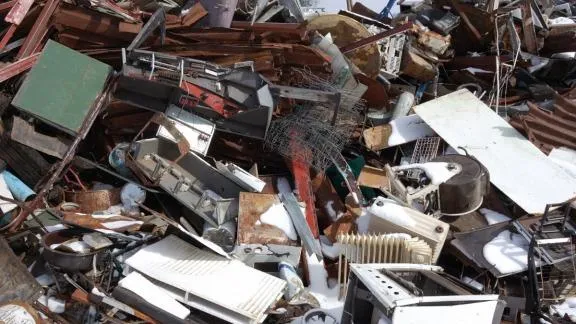
Metal is the most reliably recycled category. Appliances, bed frames, exercise equipment, piping and structural steel all have scrap value, which is why some companies pick up scrap for a reduced fee or none at all.
Cardboard, clean wood and green waste are usually diverted where facilities accept them.
Electronics are a separate stream. California treats televisions, monitors, computers and similar items as electronic waste, and they cannot lawfully be placed in landfill. A hauler taking your old television is required to route it to a certified handler.
Appliances containing refrigerant, such as fridges, freezers and air conditioners, require the refrigerant to be recovered by a certified technician before the unit is processed. This is a real regulatory requirement rather than a preference.
What Genuinely Has to Go to Landfill
Some material has no viable destination other than disposal.
Mattresses are frequently in this group, though California operates a recycling programme that some facilities participate in. Upholstered furniture in poor condition, mixed construction debris, treated wood and general household refuse usually end up at a transfer station or landfill.
Locally, that means facilities such as San Timoteo, Mid-Valley and Lamb Canyon depending on the material and where the job was.
A hauler telling you that nothing goes to landfill is not being straight with you. The honest position is that a good operator minimises what does, and can tell you roughly what proportion that was.
What Nobody Will Take
Hazardous material is excluded regardless of who you hire, and for good reason.
Paint, solvents, pesticides, fuel, used oil, car batteries, tyres and anything containing asbestos all require handling through a household hazardous waste facility.
San Bernardino and Riverside County both operate collection sites for residents, generally free for household quantities. Finding this out before a scheduled pickup avoids a wasted visit for both parties.
If you are unsure whether something qualifies, ask during the quote. Most experienced crews can identify a problem item on sight during a cleanout or trashout walkthrough.
How to Tell If a Company Actually Diverts
Ask directly what happens to the load. A company with a real process will answer specifically, naming the charities and facilities it uses.
Ask whether they can provide disposal documentation. Some will supply photographs or receipts from the drop off if requested, which is a reasonable thing to want on a large job.
Be sceptical of unusually low pricing. Proper sorting and lawful disposal cost money, and a price well below everyone else usually means one of those steps was skipped.
Licensing and insurance matter here too. Illegal dumping is traced back to the origin of the waste more often than people realise, and the property owner is not always insulated from that. Choosing a licensed junk removal service in Highland and the surrounding cities protects you as well as the outcome.
Frequently Asked Questions
Does junk removal recycle or does everything go to landfill?
It varies by company. Responsible operators sort loads and divert metal, electronics, green waste and usable goods, with only genuine refuse going to landfill. Others take everything straight to disposal. Asking what happens to the load is the fastest way to tell which you are dealing with.
What happens to furniture after junk removal?
Furniture in serviceable condition is commonly donated to charities such as Goodwill or the Salvation Army. Items that are torn, stained, structurally damaged or upholstered beyond acceptable condition are generally refused by charities and go to disposal instead.
Can old televisions and computers be thrown away in California?
No. California classifies televisions, monitors, computers and similar devices as electronic waste, and landfill disposal is prohibited. They must be routed to a certified electronic waste handler, which any licensed hauler should be doing as a matter of course.
What happens to old refrigerators and air conditioners?
Units containing refrigerant require recovery by a certified technician before the appliance can be processed or scrapped. The metal is then recycled. This is a regulatory requirement, which is why some haulers charge extra for these items.
Where can I dispose of paint, chemicals and batteries?
Through a household hazardous waste facility. Both San Bernardino and Riverside County operate collection sites, usually free for household quantities. No junk removal company or dumpster service can lawfully accept these materials as part of a normal load.
